Smith-Magenis syndrome
One of the reasons we started this campaign is that we also want to raise awareness of Smith-Magenis syndrome. So on this page, we would like to explain a little more about what actually happens in your body when you have SMS.
RAI1 protein
The cells in your body produce all kinds of proteins, and one of these is the RAI1 protein. This protein plays an important role in the development and functioning of the body, including the brain. Among other things, it helps regulate the activity of other genes and plays an important role in various processes in the body, including the day-night rhythm and development.
The instructions that tell your cells how to make proteins are stored in genes. These genes are located on your chromosomes. Most cells in your body contain 23 pairs of chromosomes: one chromosome in each pair comes from your mother and the other from your father. The unique combination of DNA you start with is created when your mother's egg is fertilised by your father's sperm. Roughly half of your DNA comes from your mother and half from your father. As you then grow as an embryo, that DNA is copied each time your cells divide, eventually happening trillions of times. And bear in mind that our DNA consists of around 3 billion base pairs (the coloured blocks in the illustration below), all of which have to be copied each time.
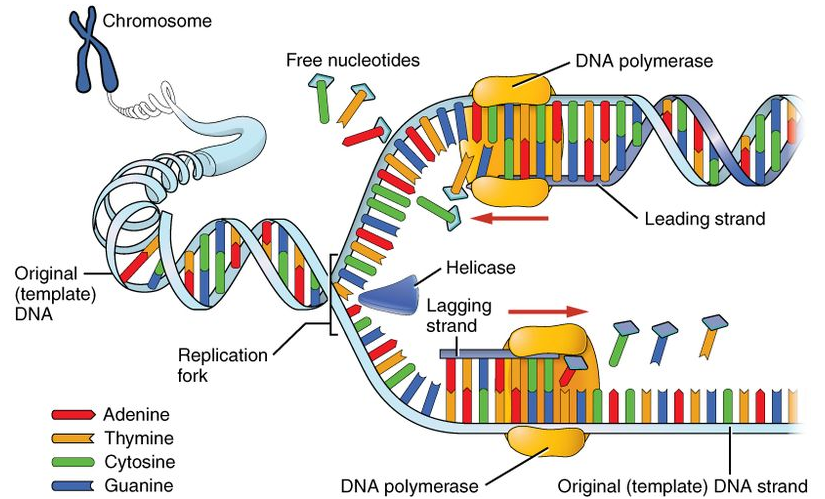
For almost all our genes, we therefore have two copies: one from our mother and one from our father. The RAI1 gene is a section of DNA on chromosome 17 containing the instructions a cell needs to make the RAI1 protein.
Two copies
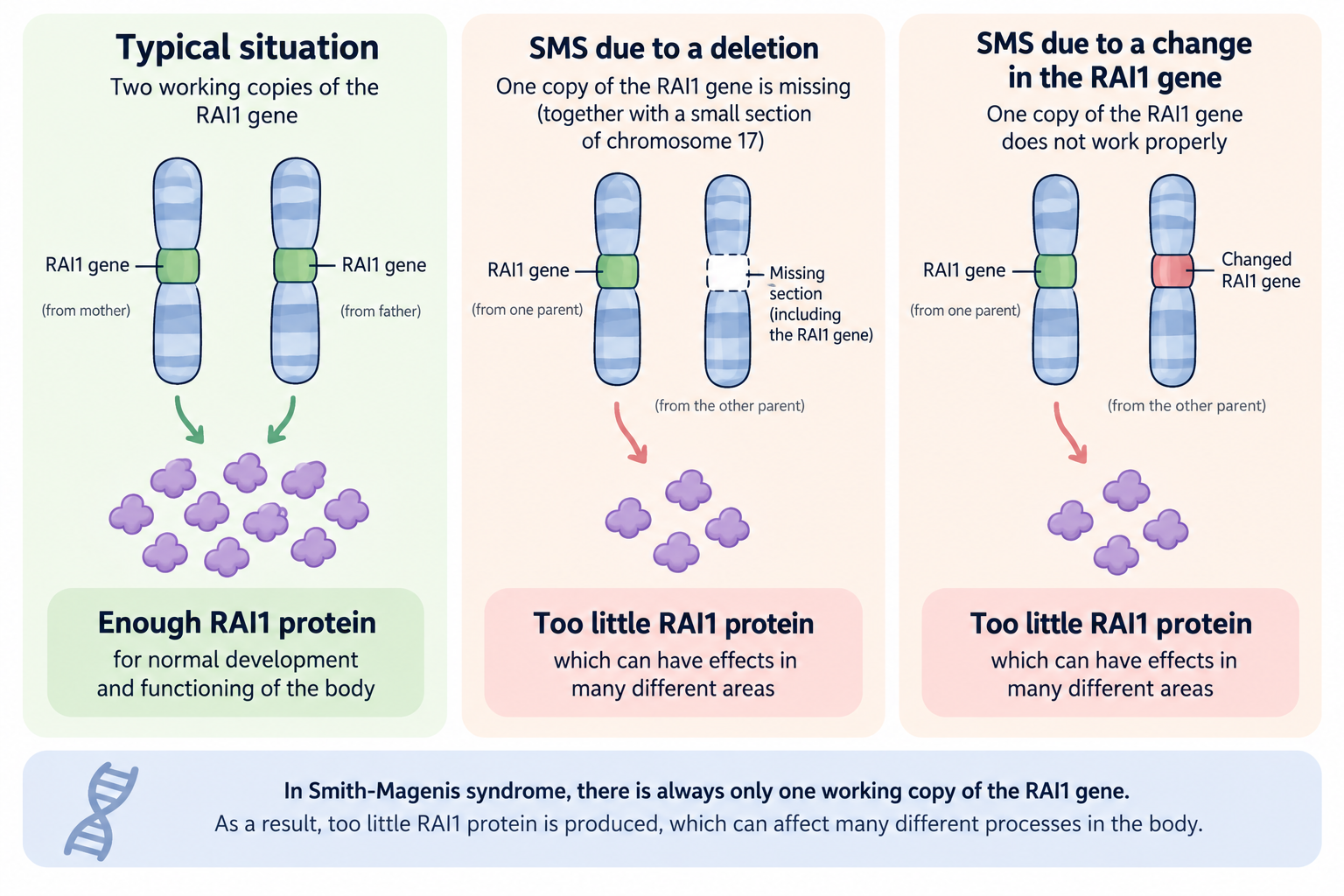
For many genes, one properly functioning copy is enough. If the other stops working, the cell can still use that one copy to produce enough of the protein it needs, and you may not notice any effects. Unfortunately, the RAI1 gene works differently: one properly functioning copy is not enough. If one of the two copies is missing or does not work properly, too little RAI1 protein is produced. And because RAI1 is involved in many different processes in the body, this can have effects in many different areas.
In most people with SMS, a small section of chromosome 17 that includes the RAI1 gene is missing. This is called a deletion. In a smaller proportion of people, the RAI1 gene itself has changed, causing one copy to no longer work properly. In both cases, one properly functioning copy of RAI1 is missing, although a deletion can mean that other genes are missing as well.
A change like this usually occurs spontaneously. It can happen, for example, when an egg or sperm cell is being formed, or very early after fertilisation. Passing on, combining and copying DNA is an incredibly complex process. It almost always goes well, but occasionally a change occurs. If this means that one copy of the RAI1 gene is missing or does not work properly, Smith-Magenis syndrome can result.
Too little RAI1 protein
The RAI1 protein produced in your cells plays a role in many different processes. Among other things, it helps regulate the activity of other genes. So if there is too little RAI1 protein, it can have effects in several areas at the same time.
One example is the day-night rhythm. In people with SMS, the regulation of the sleep hormone melatonin is often disrupted. Melatonin is normally produced mainly in the evening and at night, helping you to feel sleepy and sleep. In many people with SMS, this rhythm is more or less reversed: their bodies produce a lot of melatonin during the day and less at night. This helps explain why sleep problems and daytime sleepiness are such characteristic features of SMS.
RAI1 also plays a role in the development of the brain and nervous system. A shortage of RAI1 can therefore also have effects on areas such as learning, speech and communication, motor development and behaviour. Researchers still do not fully understand exactly how a shortage of RAI1 leads to all these different characteristics. And in people who are missing a section of chromosome 17, the other genes that would normally be present in that missing section may also play a role.
Complex
This is also what makes SMS so complex: the same genetic cause can show itself in many different ways. Not everyone with SMS has the same characteristics or experiences them to the same degree.
Of course, a person is so much more than a syndrome. We know that all too well from Sien: first and foremost, she is simply a sweet, curious and adventurous little girl whom we are very proud of. And in the same way, everyone with SMS is first and foremost a unique person, with their own character, abilities, preferences and quirks. But understanding what SMS means can help us to understand someone better and provide the right support. That is why, with Step Up for SMS, we not only want to raise money, but also to raise awareness of Smith-Magenis syndrome and share what we know about it.